

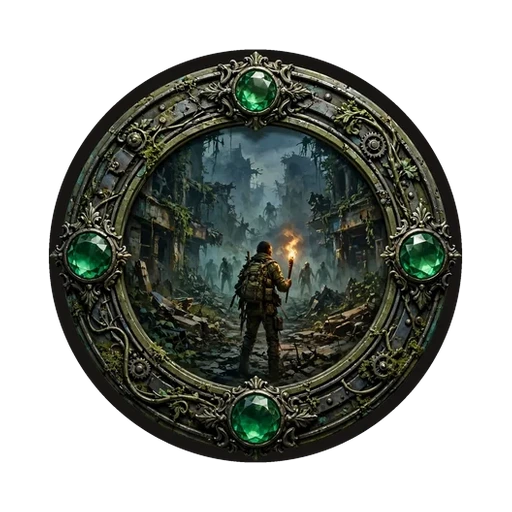

Read This First: Early Access December 8, 2026

Never Be Alone enters Steam Early Access on December 8, 2026, at 09:00 UTC — and its leveling is confirmed but undocumented. Steam lists "skill progression and character stats" as a feature, and the demo trailer shows a skill tree with three branches — Survival, Agility, Combat — but no skill list, no XP rates, and no level cap have been published. This guide is a launch-watch guide: it covers what the demo actually teaches, what the store page confirms, and what to prepare before Early Access starts — and it says so plainly wherever a number is not confirmed instead of inventing one. Do not plan a build around any skill list you find online. None of them is official.
The game is an open-world zombie survival game from Beast Studios, developed by Jonas Jensen and Wes Larkin and published by Beast Studios ApS. It is set ten years after an outbreak: cities reclaimed by nature, vines crawling across abandoned buildings, and the remnants of humanity clinging to survival. You wake after a six-month coma inside a fragile, isolated safezone with no memory of who you are or what happened before you were found. The settlement is vulnerable, its supplies are limited, and every person must contribute if it is going to survive. That last sentence is the whole game in miniature — and the whole leveling philosophy. In Never Be Alone, you do not level by killing things for XP. You level by keeping a community alive, and the community is the progression.
A free demo has been live on Steam since October 19, 2026, and the developers say they will keep it up until the game releases. The demo is the most useful leveling tool that exists for this game, and it is free: the opening 10 missions of the campaign on one of the three islands planned for Early Access, with the systems — survival, crafting, scavenging, vehicles, farming, the skill tree — already in it. Everything in this guide that is practical rather than theoretical comes from what the demo and the store page actually show. Use the demo before December 8. It is the only place the leveling exists yet.
The Demo Is Your Training Ground
The demo is not a teaser. It is the opening chapter of the game, playable solo or in co-op, and the developers describe it as "many hours" of play. It includes the opening 10 missions of the campaign, introducing you to the safezone, its survivors, and the dangers waiting beyond its walls. The demo takes place on one of the three islands planned for Early Access, and its story can reach two different major outcomes, with eight different ways events can play out depending on your actions, successes, failures, and decisions — not counting the smaller dialogue variations driven by weather, time of day, previous conversations, and discoveries made during your journey.
That structure is the first leveling lesson: the campaign is the real progression track, and it is reactive. Missions adapt in real time to what you do. Objectives, dialogue, character reactions, and mission outcomes change depending on how you approach each situation. A failed mission is not a reset — it changes where the story goes, and characters remember it. The people you rescue or leave behind can change what happens on later jobs. If you treat the demo as a shooting gallery, you will learn to shoot. If you treat it as a rehearsal for the campaign, you will learn the game.
The demo also has a tool no launch guide can give you: toggles and sliders under Settings and Gameplay that make survival more relaxed or harder. Use them. Play your first demo run on a relaxed setting and learn the systems — the survival meters, the scavenging, the crafting, the skill tree — without the pressure of a hard survival clock. Then turn the difficulty up and learn what the systems feel like under stress. The point is not to finish the demo on easy; it is to arrive on December 8 already knowing which systems you are good at and which ones kill you. That knowledge is the leveling head start, because Early Access will not give you a second tutorial.
One practical note: the demo received an update about two days after it launched, covering controls and bug fixes. The developers are actively patching it, and the demo you play in late November may not be the demo that launched on October 19. That is a good sign — it means feedback is being read — but it also means any specific demo detail in this guide should be checked against the current build. The systems are the same; the tuning moves.
Skill Progression: Survival, Agility, Combat
Here is the whole of what is confirmed about leveling in Never Be Alone: Steam lists "skill progression and character stats" as a feature, and the demo trailer's UI shots show a skill tree with three branches — Survival, Agility, Combat. That is it. No skill list, no XP sources, no XP rates, no level cap, no perk list. The guide that pretends otherwise is inventing a game.
But the three branch names are worth more than they look, because they tell you how the developers think about progression. This is not a class system. It is a survivor system, and the three branches map to the three jobs a survivor actually does. Use the demo to try each job on its own terms: one run where your priority is keeping yourself fed and warm, one run where your priority is moving through the world without being seen, and one run where your priority is fighting well. Three runs, three jobs, and by the third you will know which of the three you are actually good at — which is the only build decision that matters before the numbers exist, and the only one the demo can answer for you.
| Branch | What it covers (from the game's confirmed systems) | What to practice in the demo |
|---|---|---|
| Survival | Health, hunger, thirst, temperature; farming, hunting, fishing, gathering; safezone upkeep | Keep yourself fed and warm through a full day-night cycle; tend a crop; manage water |
| Agility | Movement — more than 550 animations, climbing, crouching, moving through windows; stealth and evasion | Move quietly through an infected area; use poor weather to move unseen; track footprints |
| Combat | Weapons, attachments, melee and firearms; noise discipline; fighting the infected and hostile survivors | Fight one group loud and one group quiet; compare the attention each draws |
Read the table as a set of questions, not answers. The game has not said which branch gates what, whether XP comes from use or from mission rewards, or whether there is a cap at all. What the branch names do tell you is where to spend your demo hours: one run focused on keeping the safezone fed and watered, one run focused on moving through the world without being seen, and one run focused on fighting — and then, on December 8, you will know which of the three you are actually good at, which is the only build decision that matters before the numbers exist.
The build question, answered honestly: there is no best build to recommend yet, because no skill list has been published. The correct pre-launch build is a balanced survivor: competent at feeding yourself, competent at moving quietly, competent at fighting when you must. Specialization is a decision for after the skill list is public and the community has measured what each branch actually does. A specialist built on guesses is a survivor with one skill and three weaknesses.
Character Stats and Customization
Character stats are confirmed as a feature, and character customization is confirmed too — different character options, hairstyles, beards, and clothing. That is the whole of what is published about them. No stat list, no numbers, no explanation of what the stats do.
What the customization does tell you is something about the game's priorities. This is a game where you build a survivor who represents you — the store page says so directly — and where the campaign is fully voiced with more than 1,000 lines of real voice acting. The character is not a blank avatar. It is a person with a past you are uncovering, a face you chose, and a community that reacts to what you do. Leveling in this game is not just numbers going up; it is a survivor becoming someone the safezone relies on. Play it that way in the demo: learn the names — Magnus, Captain Sable, Captain Morse — learn who they are, and learn what they ask of you. The characters remember what happened. That is a mechanic, not flavor.
Missions: The Campaign Is the Real Progression
If skill progression is the undocumented half of leveling, the campaign is the documented half — and it is the half that matters more. The Early Access plan spans three islands and more than 30 main missions, with over 1,000 lines of voice acting, per the Steam page. The demo's first ten missions take place on one island. The full campaign is the road through the other two, and the missions are the levels.
The campaign's defining feature is that it reacts. Missions adapt in real time to your actions and choices, mission successes and failures, the survivors you rescue or leave behind, weather conditions, time of day, and previous conversations and discoveries. The demo's ten missions have two major outcomes and eight ways for events to play out — and that is before counting the smaller dialogue variations. No two groups will experience the story in exactly the same way, per the store page, and that is not marketing language. It is a design statement: the campaign is a branching structure, not a corridor, and your choices are the progression.
That has a direct consequence for how you should play. In a linear game, the leveling advice is "do the missions in order." In this game, the leveling advice is "do the missions, and understand that how you do them is the leveling." A mission completed cleanly, with survivors rescued and supplies brought home, is a different outcome from the same mission completed messily with people left behind — and the game remembers the difference. The survivors you bring back alive can change what happens on later jobs. Characters react differently depending on mission outcomes. The safezone itself is a progression system: it endures or it does not, based on what you do.
Choices That Change the Story
Rescues are the leveling decision that matters most. The preview coverage and the store page agree on this point from different directions: the people you save — or fail to save — change mission outcomes, change character reactions, and change what happens later. A rescue is not a side objective. It is a branch in the campaign, and branches compound.
Think about that the way a WoW player thinks about a raid roster. In a raid, the players you bring determine what you can kill. In Never Be Alone, the survivors you bring home determine what the safezone can do, what missions become available, and how the story treats you. A survivor left behind is not just a lost quest reward; it is a lost person, a lost set of hands, and a story that remembers you left them. A survivor rescued is a new option — a new conversation, a new mission variant, a new pair of hands for the fields or the walls.
The practical advice follows from that. First, do not rush missions. A mission completed fast with survivors abandoned is worth less than a mission completed carefully with everyone brought home. Second, learn the safezone's people — Magnus, Captain Sable, Captain Morse, and whoever else you meet in the demo — because their missions are the ones that carry the story, and their reactions are the game's memory of you. Third, accept that failure is a branch, not a game over. A failed mission changes where the story goes. That is not a punishment. It is the game working as designed. But it is also a reason to play carefully: the branch you take by failing is rarely the branch you would have chosen.
Survival Systems: The Daily Grind
Survival is the daily grind, and it is also the leveling grind, because the skill tree's Survival branch is built from it. Health, hunger, thirst, and temperature — four meters, all confirmed — with dynamic weather (snow, rain, fog, storms) and a day and night cycle that changes visibility and which infected appear. The world also reacts to the time of day: certain missions, conversations, events, and infected may only appear under specific conditions.
Weather is not decoration here. It changes how you survive. Snow, rain, fog, and storms affect visibility, exploration, and combat. You can track footprints through snow and mud, use poor weather to move unseen, and prepare for conditions that can make even familiar routes dangerous. The demo trailer adds the detail that matters most for the farming side of this game: solar panels need sunlight, windmills need wind, and extreme storms can knock both out completely. Power is weather, and weather is survival.
The survival loop, as confirmed, looks like this: eat, drink, stay warm, stay alive — and do it while the weather changes the rules. The demo's difficulty sliders let you practice that loop at a forgiving setting before Early Access starts, and you should. Learn how fast hunger moves, how cold the nights get, and how much a storm costs you, while the stakes are low. On December 8, the stakes are real, the islands are three instead of one, and the safezone is counting on you to already know.
The Infected: Know What Hunts You
There are 11 distinct types of infected, each with different behaviours, strengths, and weaknesses. Five are named on the store page, and the other six are unconfirmed — no full list has been published. Learn the five, respect the six, and do not trust any "complete infected guide" that appears before players have documented all eleven.
| Infected | What is confirmed | How to handle it |
|---|---|---|
| Sprinters | Fast-moving | Do not try to outrun them in the open; break line of sight, use terrain, fight on your terms |
| Ferals | Four-legged | Low, fast, and hard to track in tall grass — listen for them before you see them |
| Toxic mutations | Toxic — mutated | Keep distance; whatever they exhale or leak is not something to stand in |
| Brutes | Heavily transformed | Do not fight fair — use noise discipline, terrain, and numbers, or do not fight at all |
| Night Roarer | Rare, powerful, nocturnal — hunts after dark | Plan night movement around it; do not be out after dark unprepared |
| 6 more types | Unconfirmed — no names published | Learn them from launch-week play; do not trust pre-launch lists |
Two mechanics govern every infected encounter, and both are confirmed. First, noise. Every gunshot creates noise, and noise attracts attention — the store page says so directly, and the demo page repeats it. A loud fight is a fight that invites a second fight. A quiet kill — by hand or with a knife, per the demo trailer — is a fight that stays a single fight. The Agility branch exists for a reason: the survivor who can move quietly and kill quietly is the survivor who controls how many enemies they face at once.
Second, time of day. The Night Roarer hunts after dark, and certain infected may only appear under specific conditions. Night is not just darker; it is a different game, with different enemies and different risks. Plan your movement around it. Do your long supply runs in daylight. Be home — or fortified — after dark. And if you must move at night, move quietly, move with friends, and know what is hunting.
Some infected have survived long enough to undergo extreme mutations, becoming far more dangerous than the people or animals they once were. That is the store page's warning, and it is worth hearing: the longer the outbreak runs, the worse the things in it get. The infected are not a static enemy list. They are a ladder, and the top of the ladder is something you have not met yet.
Human Factions: The Other Threat
The infected are not the only danger. The game has human factions — military forces, bandits, scavengers, and other survivors with their own rules, territories, and motives. Some may be willing to cooperate. Others will threaten your home, steal what you need, or test how far you are willing to go to protect your people.
That is a different kind of leveling problem from the infected, because humans negotiate. A Brute does not care about your supplies; a bandit does. A Sprinter does not hold territory; a military force does. The factions have territories, and the world to scavenge — cities, farms, military locations, survivor camps, industrial areas — is also faction ground. Military sites and farms are the named loot ground, but they are also the places where someone else's rules apply.
The practical advice is simple and comes from the game's own framing: learn who holds what before you walk into it. A scavenging run into a military location is a different mission from a scavenging run into an empty farm, and the difference is not the loot — it is the people. Some factions will cooperate. Find out which ones before you need them, not after you have already made an enemy of them. And remember that the campaign's choice system applies to factions too: the people you help, the people you rob, and the people you leave behind all remember it.
Co-op Leveling: Never Alone, Literally
Co-op is the headline feature, and it changes leveling in a way no solo guide can fully capture. The game supports seamless co-op with no fixed player limit — as many players as the host computer can handle. Solo or co-op, the same campaign, the same safezone, the same survival. But a group levels differently from a solo player, and the differences are worth planning for.
First, a group shares supplies, and sharing is a mechanic: explore together, share supplies, coordinate attacks, travel in vehicles, and help keep one another alive. A group that shares is a group that survives; a group that hoards is a group that fractures. Second, a group divides labor. One player farms while another scouts. One player builds while another runs supplies. The Survival, Agility, and Combat branches map neatly onto group roles — the farmer, the scout, the fighter — and a group that assigns roles deliberately will level faster than a group of four generalists all doing the same thing. Third, a group is louder. More players, more noise, more attention. The demo trailer's note that every shot attracts the infected applies double in co-op, where four players can make four times the noise without meaning to.
Play the demo in co-op before December 8 if you can. The demo supports solo or online co-op, and the developers promise "many hours" of play either way. A co-op demo run teaches you things a solo run cannot: how your group communicates, who leads, who scouts, who carries, and whether your group actually shares supplies or just says it does. Those are the questions that decide whether your Early Access group thrives or falls apart in the first week — and they are much cheaper to answer in a free demo than in a live Early Access launch.
Combat and Stealth: Loud, Quiet, or Not at All
Combat in Never Be Alone is a choice, not a default. You can switch freely between first- and third-person views — first person for immersion and detailed exploration, third person for awareness during movement, combat, and co-op play. More than 550 animations make the survivor feel physical and grounded: moving through windows, crouching beneath obstacles, climbing across the environment, interacting with containers. That movement set is the stealth kit. Use it.
Weapons can be found and customized with attachments — scopes, suppressors, flashlights, extended magazines — but every attachment is a trade-off, and the biggest trade-off is noise. A suppressor makes you quieter. A flashlight makes you visible. A scope makes you accurate at range and blind up close. Choose equipment for the situation, and remember the rule the store page states twice: every gunshot creates noise, and noise attracts attention. The demo trailer's version is blunter — fight or sneak, and every approach plays differently. Fight a group head-on, or stay quiet and take them down by hand or with a knife. Both work. Only one of them keeps the next group from arriving.
The third option is the one new players forget: not at all. Some fights are not worth fighting. A Brute in the open, a pack of Sprinters between you and a loot room, a Night Roarer after dark — the correct play is often to go around, wait for daylight, or come back with friends. In a game where the campaign remembers your failures, a fight avoided is a branch not taken badly. Stealth is not cowardice. It is the Agility branch doing its job.
The Safezone: Your Other Character
The safezone is not a hub. It is a character — the other one you are leveling — and it is the progression system most players will underestimate. You wake inside it after a six-month coma, with no memory, and the settlement is vulnerable, its supplies are limited, and every person must contribute if it is going to survive. That is not backstory. It is the game loop.
The safezone levels through you. Missions bring supplies home. Rescues bring people home. Farming feeds the people. Base building fortifies the walls. Power keeps the lights on. Every system in the game feeds the safezone, and the safezone feeds the campaign back: a safezone that endures opens missions, alliances, and story; a safezone that fails closes them. The developers describe the Early Access version as including "safe zones, NPCs, and quests" as core systems, and the campaign as a story about helping your safezone endure, forming crucial alliances, encountering competing factions, and uncovering clues about the life you lived before the outbreak.
Think about the safezone the way a WoW player thinks about a guild hall or a garrison — except the guild hall has a memory. The people in it react to what you do. Characters remember mission outcomes. Survivors you rescue change what happens later. The safezone is not a place you return to between missions; it is the thing the missions are for. A player who treats it as a lobby will level their character and lose their settlement. A player who treats it as the progression will level both.
The practical advice is to invest in the safezone from day one, not as an afterthought. Farm before you are hungry. Fortify before you are attacked. Rescue before you are asked twice. The safezone's needs are the game's quest log, and the quest log is the leveling guide.
Day and Night: Planning Around the Clock
The day and night cycle is a mechanic, not a skybox. The world reacts to the time of day: certain missions, conversations, events, and infected may only appear under specific conditions. The Night Roarer — a rare, powerful, nocturnal infected — hunts after dark. That single fact should shape your whole schedule, because night in this game is not just darker. It is a different game, with different enemies and different risks.
Plan your days around the light. Do your long supply runs, your far scavenging, and your loud missions in daylight, when visibility is good and the nocturnal infected are not hunting. Use poor weather to move unseen — rain, fog, and storms reduce visibility for the infected as well as for you, and the store page explicitly says you can use poor weather to move unseen and track footprints through snow and mud. That is a stealth system built from the weather itself: the same storm that kills your solar panels is the storm that hides your movement.
Evenings are for coming home. Be home — or fortified — before dark, and use the night for base work: crafting, planning, tending what can be tended indoors, and resting. If you must move at night, move quietly, move with friends, and know what is hunting. The Night Roarer is rare, but rare does not mean absent, and a night run that meets one unprepared is a run that ends badly. The clock is a resource. Spend your daylight, save your nights, and let the cycle work for you instead of against you.
The Early Access Launch Plan
| When | Do this | Why |
|---|---|---|
| Before Dec 8 | Play the demo — relaxed setting first, then harder; solo and co-op | Learn the systems while stakes are low; find your group's roles |
| Before Dec 8 | Learn the three skill branches by feel; do not plan a build from unofficial lists | No skill list is published; feel beats theory |
| Day 1 | Play the campaign missions in order; rescue everyone you can | Missions are the progression; rescues change later outcomes |
| Day 1 | Set up farming and water before your first long run | A failed crop is as dangerous as an infected attack |
| Days 2–3 | Scout the first island thoroughly; learn which factions hold what | Faction ground is loot ground — know whose rules apply |
| Days 2–3 | Test noise discipline: one loud run, one quiet run, compare the attention | Noise is the mechanic that decides how many enemies you face |
| Days 4–5 | Read the first community skill reports; specialize only with evidence | The skill list lands in launch week — use it, do not guess ahead of it |
| Days 6–7 | Plan your second island push with your group; bring vehicles, fuel, and food | Three islands, one safezone — expansion needs logistics, not courage |
The through-line is the same as every survival game, and this one states it in its own title: never be alone. Play the demo, learn the systems, bring your people, rescue the ones you find, and do not fight the fights you can walk around. The levels will come. The survivors are the point.
Common Mistakes
- Skipping the demo. It is free, it is the opening chapter, and it is the only place the leveling exists before December 8. Arriving without it is arriving blind.
- Planning a build from an unofficial skill list. No skill list has been published. The three branches — Survival, Agility, Combat — are the whole confirmed picture.
- Rushing missions and abandoning survivors. Rescues change later outcomes. A mission completed fast with people left behind is worth less than one completed carefully with everyone brought home.
- Fighting loud by default. Every gunshot attracts the infected. A loud fight invites a second fight. Learn to kill quietly.
- Moving at night unprepared. The Night Roarer hunts after dark, and certain infected only appear under specific conditions. Night is a different game.
- Ignoring farming until you are hungry. Crops, water, and power are daily jobs. A failed crop is as dangerous as an infected attack — the store page says so.
- Walking into faction territory blind. Military sites and farms are loot ground and faction ground. Learn who holds what before you go.
- Treating Early Access as a finished game. The developers estimate "many many years" in Early Access. Systems will change, balance will move, and the price will rise as content is added. Play it as a living game, not a finished one.
- Trusting a pre-launch price. No price has been announced. Any figure you see — including a €15–20 range mentioned in one creator video's comments — is unconfirmed, not official.
Patch State and What to Watch After Launch
State as of November 11, 2026: Never Be Alone is unlaunched. Early Access begins December 8, 2026, at 09:00 UTC on Steam (Windows PC), with a demo live since October 19, 2026 that the developers will keep up until release. The developers estimate Early Access will last "many many years," with the price lower during Early Access and possibly rising slightly as content is added. No price has been announced. The demo received a controls-and-bug-fixes update about two days after launch, and the developers' stated plan is regular updates, patch notes, and honest communication through Discord and the Steam forums.
What to watch in launch week, in order: the first published skill list — it decides every build in this guide; the first XP measurements — they decide whether progression is a grind or a sprint; the first reports from the second and third islands — the demo covers one, and the other two are unplayed ground; the first price announcement — because the developers have said Early Access pricing rewards early supporters and may rise later; and the first Early Access patch notes — because a game that plans to be in Early Access for years will change fastest in its first month. If any of those discoveries contradicts a plan in this guide, the plan is wrong and the discovery is right. Check the Steam store page and the developers' Discord for the launch-day details this guide could not carry, because pre-launch information is thin by nature and launch day is when the real leveling guide gets written — by the players, in the game.
Related pages:
 Never Be Alone
Frequently Asked Questions
When does Never Be Alone enter Early Access?
December 8, 2026, at 09:00 UTC, on Steam for Windows PC, per SteamDB’s store release date. A free demo has been live since October 19, 2026, and the developers say they will keep it up until the game releases.
How does leveling work in Never Be Alone?
Through skill progression and character stats, both listed as Steam features. The demo trailer shows a skill tree with three branches — Survival, Agility, Combat — but no skill list, XP rates, or level cap have been published. The campaign, with over 30 main missions across three islands, is the real progression track.
Is there a Never Be Alone demo?
Yes. A free demo has been live on Steam since October 19, 2026, with the opening 10 missions on one of the three islands planned for Early Access. It has difficulty toggles and sliders under Settings and Gameplay, and the developers promise many hours of play, solo or in co-op.
How many missions are in Never Be Alone?
More than 30 main missions across three islands, with over 1,000 lines of real voice acting, per the Steam page. The demo’s 10 missions have two major outcomes and eight ways for events to play out.
What infected types are in Never Be Alone?
Eleven distinct types, each with different behaviours, strengths, and weaknesses. Five are named: fast-moving Sprinters, four-legged Ferals, toxic mutations, heavily transformed Brutes, and the rare nocturnal Night Roarer, which hunts after dark. The other six have not been named in any published source.
Does Never Be Alone have co-op?
Yes — seamless co-op with no fixed player limit, as many players as the host computer can handle, per Steam. You can play solo or team up with friends to explore together, share supplies, coordinate attacks, travel in vehicles, and build fortified places to survive.
How much will Never Be Alone cost?
The price has not been announced. The developers say it will remain lower during Early Access to reward early supporters, and may increase slightly as the game approaches full release. Any figure you see before an official announcement — including a €15–20 range mentioned in one creator video’s comments — is unconfirmed.
How long will Never Be Alone be in Early Access?
The developers estimate “many many years.” The full version is planned to expand the story, missions, locations, enemies, items, and systems based on player feedback, with regular updates and patch notes throughout.
Sources
Every fact in this guide carries its source. Launch and system facts come from Steam and the developers directly; where a number is not published, the guide says so rather than inventing one. Last checked November 11, 2026.
- Steam: Never Be Alone store page (Early Access December 8, 2026; features; Early Access plan)
- Steam: Never Be Alone Demo (opening 10 missions, one island, demo since October 19, 2026)
- SteamDB: Never Be Alone — store release date 8 December 2026, 09:00:00 UTC
- GameBrief: Steam Next Fest Co-op Demos — 185,500+ wishlists; demo details (October 2026)
- Pixel Herald: Never Be Alone Demo Launches October 19 for Steam Next Fest (185,000 wishlists; languages)
- Game*Spark: Never Be Alone demo coverage — 185,000+ wishlists, three islands, 30+ missions (October 18, 2026)
- Game*Spark: Never Be Alone demo now available — unlimited co-op, 10 missions (October 20, 2026)
- Game*Spark: Never Be Alone indie pick — price TBD, Japanese support (September 20, 2026)
- How To Video Game: 20 Best Steam Next Fest Demos — demo difficulty sliders, one developer, four years (October 2026)
- GAMINGbible: free demo of open-world zombie adventure (October 21, 2026)
- Beast Studios: Never Be Alone — Demo Trailer (weather and power, skill trees, fight or sneak)
- 4Gamers: demo trailer breakdown — Survival, Agility, Combat skill tree; Magnus, Captain Sable (Threads, October 20, 2026)
- PCGame: Never Be Alone — wishlist rank #214, 15K followers, demo update note (checked November 11, 2026)
- MMODude: Never Be Alone game page — 0 vendors, no verified market (November 2026 review)
